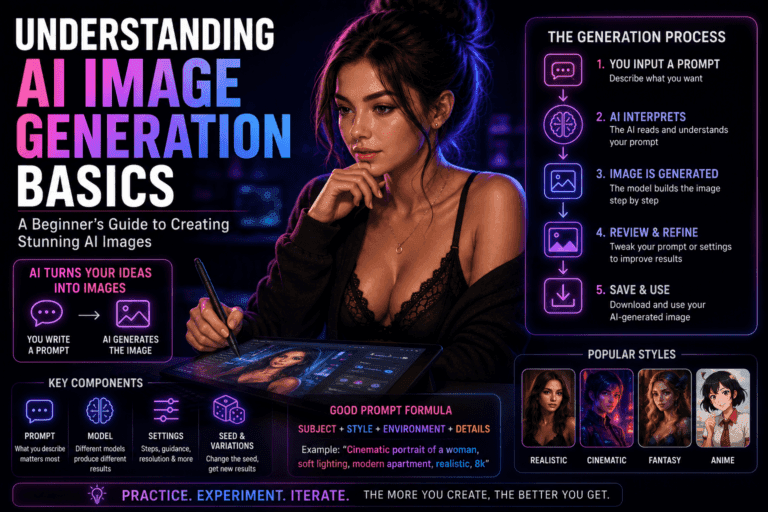
Somewhere between humanity inventing cave paintings and spending hours generating anime avatars, we decided machines should also learn how to “imagine.” That decision gave birth to AI image generation models—systems that can create visuals from noise, text, or learned patterns.
What started as blurry, nightmare-inducing outputs has evolved into shockingly realistic images that can rival professional photography and digital art. This transformation didn’t happen overnight. It’s the result of years of research, experimentation, and increasingly powerful computational resources.
In this article, we’ll walk through the full evolution of AI image generation models—from early rule-based attempts to modern diffusion models that dominate today’s landscape.
What Is AI Image Generation?
AI image generation refers to the use of machine learning models—typically deep neural networks—to create images from data. These models learn patterns from massive datasets and then generate new visuals that resemble the training data.
There are several types of generation approaches, including:
- Noise-to-image generation
n- Text-to-image generation - Image-to-image transformation
- Style transfer
At the core of all of these is one idea: teaching machines to understand visual patterns and recreate them in novel ways.
Early Foundations: Rule-Based Graphics and Procedural Generation
Before neural networks took over, image generation relied on procedural algorithms and rule-based systems. These methods were common in early computer graphics and gaming.
Procedural generation used mathematical rules to create textures, terrains, and patterns. While useful, these systems lacked adaptability. They couldn’t “learn” from data—they simply followed predefined instructions.
This limitation led researchers toward machine learning approaches, where systems could improve through exposure to data.
The Rise of Neural Networks
The introduction of neural networks marked a turning point. Early models were simple and struggled with image complexity, but they laid the groundwork for future breakthroughs.
Convolutional Neural Networks (CNNs) became especially important for image-related tasks. While primarily used for classification, they demonstrated that machines could understand visual structures.
However, generating images remained a challenge. That changed with the introduction of generative models.
Variational Autoencoders (VAEs)
VAEs were among the first successful generative models. They work by encoding images into a compressed latent space and then decoding them back into images.
How VAEs Work
- Input image is compressed into a latent representation
- Latent space is regularized to follow a probability distribution
- Decoder reconstructs the image from this representation
Strengths of VAEs
- Stable training process
- Structured latent space
- Good for interpolation
Limitations
- Blurry outputs
- Lack of fine detail
Despite their limitations, VAEs played a crucial role in advancing generative AI.
Generative Adversarial Networks (GANs)
If VAEs were the cautious academic, GANs were the chaotic genius. Introduced in 2014, GANs revolutionized image generation.
How GANs Work
GANs consist of two networks:
- Generator: creates images
- Discriminator: evaluates authenticity
They compete in a zero-sum game. The generator improves by trying to fool the discriminator, while the discriminator improves by detecting fakes.
Breakthroughs with GANs
- Photorealistic image generation
- Face generation (e.g., StyleGAN)
- Image super-resolution
Challenges
- Training instability
- Mode collapse
- Requires careful tuning
Despite their flaws, GANs dominated AI image generation for years.
Style Transfer and Creative AI
Around the same time, neural style transfer gained popularity. This technique allows one image’s style to be applied to another image’s content.
This opened the door for creative AI applications, including AI art tools and filters.
The Shift to Diffusion Models
Diffusion models represent the current state-of-the-art in AI image generation.
Instead of generating images directly, diffusion models start with noise and gradually refine it into an image.
How Diffusion Models Work
- Add noise to training images over many steps
- Train model to reverse this process
- Generate images by denoising random noise
Why Diffusion Models Are Superior
- High-quality outputs
- Stable training
- Better diversity
Models like DALL·E, Stable Diffusion, and Midjourney rely on diffusion techniques.
Text-to-Image Generation
One of the most impactful developments is text-to-image generation.
Users can describe an image in natural language, and the model generates a corresponding visual.
This combines natural language processing with image generation, creating a powerful multimodal system.
Ethical Concerns and Challenges
AI image generation raises several ethical issues:
- Deepfakes and misinformation
- Copyright concerns
- Bias in training data
As the technology advances, addressing these concerns becomes increasingly important.
Future of AI Image Generation
The future of AI image generation includes:
- Real-time generation
- Improved personalization
- Better control over outputs
- Integration with AR/VR
We are moving toward systems that can generate entire virtual worlds, not just images.
Conclusion
AI image generation has come a long way—from rigid algorithms to sophisticated models capable of producing stunning visuals.
Each stage of evolution—VAEs, GANs, and diffusion models—has contributed to the current landscape. As technology continues to advance, the line between human-created and AI-generated art will only become more blurred.
FAQs
1. What is the best AI image generation model today?
Diffusion models are currently the most advanced and widely used.
2. What is the difference between GANs and diffusion models?
GANs use a competitive approach, while diffusion models gradually refine noise into images.
3. Are AI-generated images copyrighted?
This depends on jurisdiction and platform policies.
4. Can AI replace human artists?
AI can assist but not fully replace human creativity.
5. Is AI image generation free?
Some tools are free, while others require subscriptions.