Quick Summary
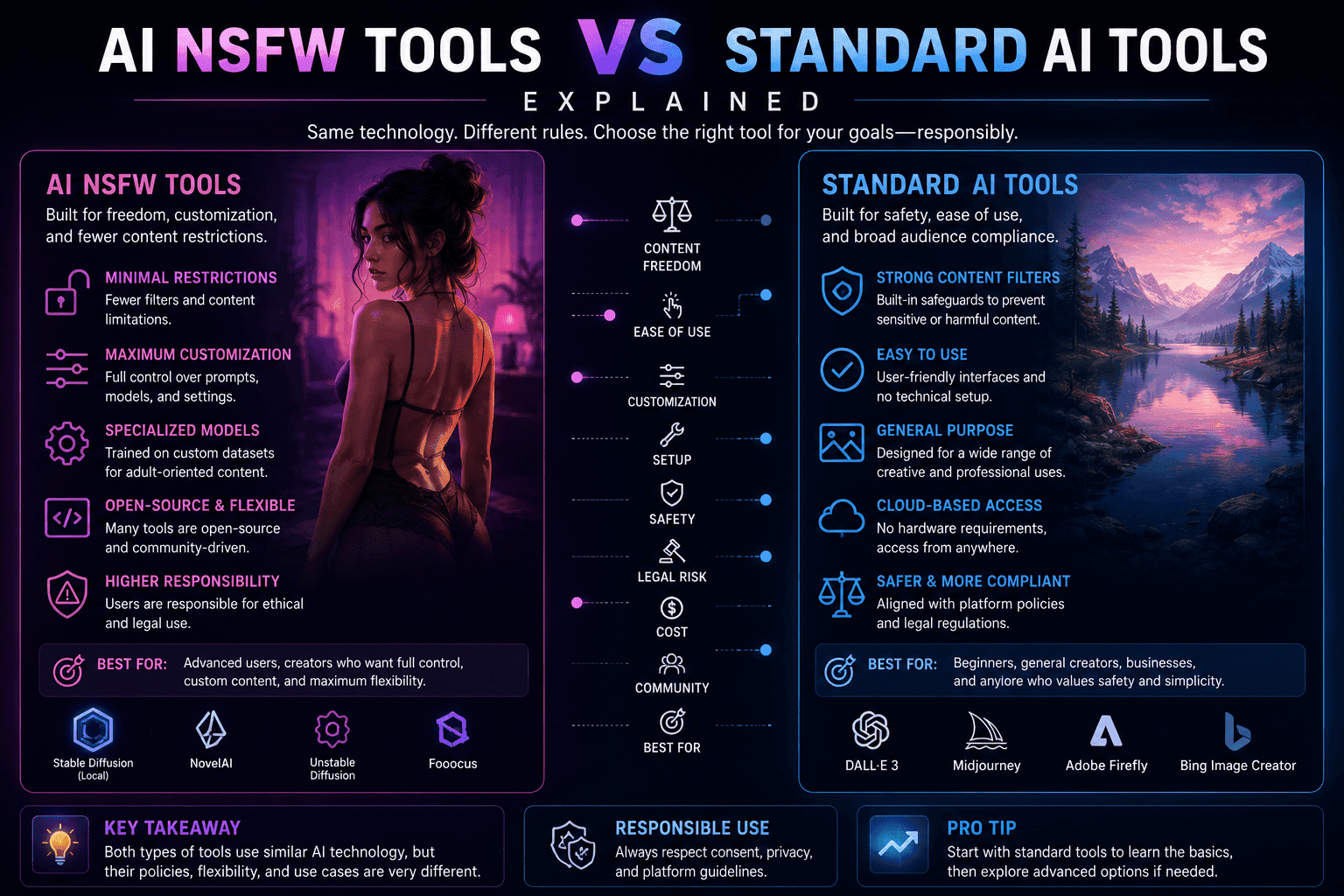
AI NSFW tools and standard AI tools use similar underlying technologies but differ significantly in content policies, flexibility, and use cases. While standard tools like Stable Diffusion (in moderated environments) and platforms from OpenAI prioritize safety and restrictions, NSFW-oriented tools offer fewer limitations, more customization, and higher risk. Understanding these differences is essential for choosing the right tool responsibly.
Introduction
Here’s the confusion most beginners have:
“Isn’t all AI the same?”
No. Not even close.
Two tools can use the same underlying model and behave completely differently depending on:
- Filters
- Training data
- Platform policies
So if you’ve ever wondered why one tool refuses your prompt while another happily generates something… yeah, that’s not random.
1. What Are Standard AI Tools?
Let’s start with the “safe” side of the internet.
Definition
Standard AI tools are platforms designed for:
- General use
- Broad audiences
- Compliance with regulations
Examples
- DALL·E
- Midjourney
- AI tools from Google
Key Characteristics
- Strong content filters
- Built-in moderation
- Restricted outputs
- Focus on safe, professional use
What They’re Best For
- Design
- Marketing visuals
- Creative projects
- General AI exploration
Reality Check
They are designed to not cross certain lines, even if users try.
Which, judging by human behavior, happens a lot.
2. What Are AI NSFW Tools?
Now we move into less regulated territory.
Definition
AI NSFW tools are systems designed or configured to generate adult-oriented or less restricted content.
How They Differ
Instead of strict filters, they often have:
- Minimal restrictions
- Custom datasets
- Specialized models
Key Characteristics
- Greater output freedom
- Fewer safeguards
- More customization options
Where They Exist
- Open-source communities
- Private deployments
- Niche platforms
Reality Check
More freedom = more responsibility.
A concept people tend to ignore until consequences show up.
3. Core Technology: Same Engine, Different Rules
Here’s the part most people don’t realize.
Both Tool Types Use Similar Tech
- Diffusion models
- Machine learning systems
- Text-to-image pipelines
For example:
- Stable Diffusion can be used in both restricted and unrestricted environments
The Real Difference
Not the model.
The configuration and control layer.
Translation
Same car engine.
Different speed limits.
4. Content Restrictions & Filters
This is the biggest difference.
Standard AI Tools
- Strict filtering
- Prompt blocking
- Output moderation
They actively prevent:
- Sensitive content
- Policy violations
- Risky outputs
NSFW AI Tools
- Minimal filtering
- User-controlled prompts
- Fewer restrictions
Trade-Off
| Feature | Standard Tools | NSFW Tools |
|---|---|---|
| Safety | High | Low |
| Freedom | Limited | High |
| Risk | Low | High |
Honest Take
Restrictions can be annoying.
But they also protect you from doing something stupid.
5. Ease of Use
Not all tools are equally beginner-friendly.
Standard Tools
- Clean UI
- Easy onboarding
- No setup required
NSFW Tools
- Often require setup
- Technical knowledge
- Manual configuration
Beginner Reality
Standard tools:
“Click and generate”
NSFW tools:
“Install this, configure that, hope it works”
6. Customization & Control
This is where NSFW tools shine.
Standard Tools
- Limited customization
- Preset styles
- Restricted outputs
NSFW Tools
- Full prompt control
- Custom models
- Fine-tuning options
Trade-Off
More control = more complexity
And more chances to mess things up.
7. Ethical & Legal Considerations
This isn’t optional, no matter how much people wish it was.
Standard Tools
- Built-in compliance
- Ethical safeguards
- Reduced legal risk
NSFW Tools
- User responsibility
- Higher risk of misuse
- Potential legal issues
Key Risks
- Misuse of likeness
- Non-consensual content
- Privacy violations
Simple Rule
Just because a tool allows something doesn’t mean it’s okay.
8. Output Quality & Flexibility
Surprisingly, both categories can produce high-quality results.
Standard Tools
- Polished outputs
- Consistent quality
- Limited variation
NSFW Tools
- Wide variation
- Experimental outputs
- Quality depends on setup
Reality
Better results often come from:
- Skill
- Prompting
- Experience
Not just the tool itself.
9. Community & Ecosystem
This affects learning more than people realize.
Standard Tools
- Official support
- Tutorials
- Documentation
NSFW Tools
- Community-driven
- Forums & Discord groups
- Less structured help
Translation
Standard tools = guided experience
NSFW tools = figure it out with strangers online
10. Cost & Accessibility
Money always enters the conversation.
Standard Tools
- Subscription-based
- Pay-per-use
- Free tiers available
NSFW Tools
- Often free (open-source)
- Hardware-dependent
- Setup costs
Hidden Truth
“Free” tools can cost more in:
- Time
- Effort
- Hardware
11. Which One Should You Choose?
Let’s make this painfully simple.
Choose Standard AI Tools If You:
- Are a beginner
- Want simplicity
- Prefer safety
- Don’t want legal headaches
Choose NSFW AI Tools If You:
- Understand the risks
- Need full control
- Are comfortable with technical setup
- Take responsibility seriously
Brutally Honest Advice
Start with standard tools.
Then move to advanced setups only if you actually need them.
Not because you’re curious and bored.
12. Common Misconceptions
Let’s clean up some nonsense.
“NSFW Tools Are Better”
Not necessarily.
They’re just less restricted.
“Standard Tools Are Useless”
Also false.
They’re designed for different use cases.
“More Freedom = Better Results”
No.
More freedom = more responsibility (and more ways to mess up).
Final Thoughts
AI NSFW tools and standard AI tools are not competitors.
They are different environments built on similar technology.
Standard tools offer:
- Safety
- Simplicity
- Compliance
NSFW tools offer:
- Freedom
- Customization
- Flexibility
The “best” choice depends on:
- Your goals
- Your experience
- Your willingness to handle responsibility
Because at the end of the day, the tool doesn’t decide what gets created.
You do.
Which is… comforting and slightly concerning at the same time. 😌