
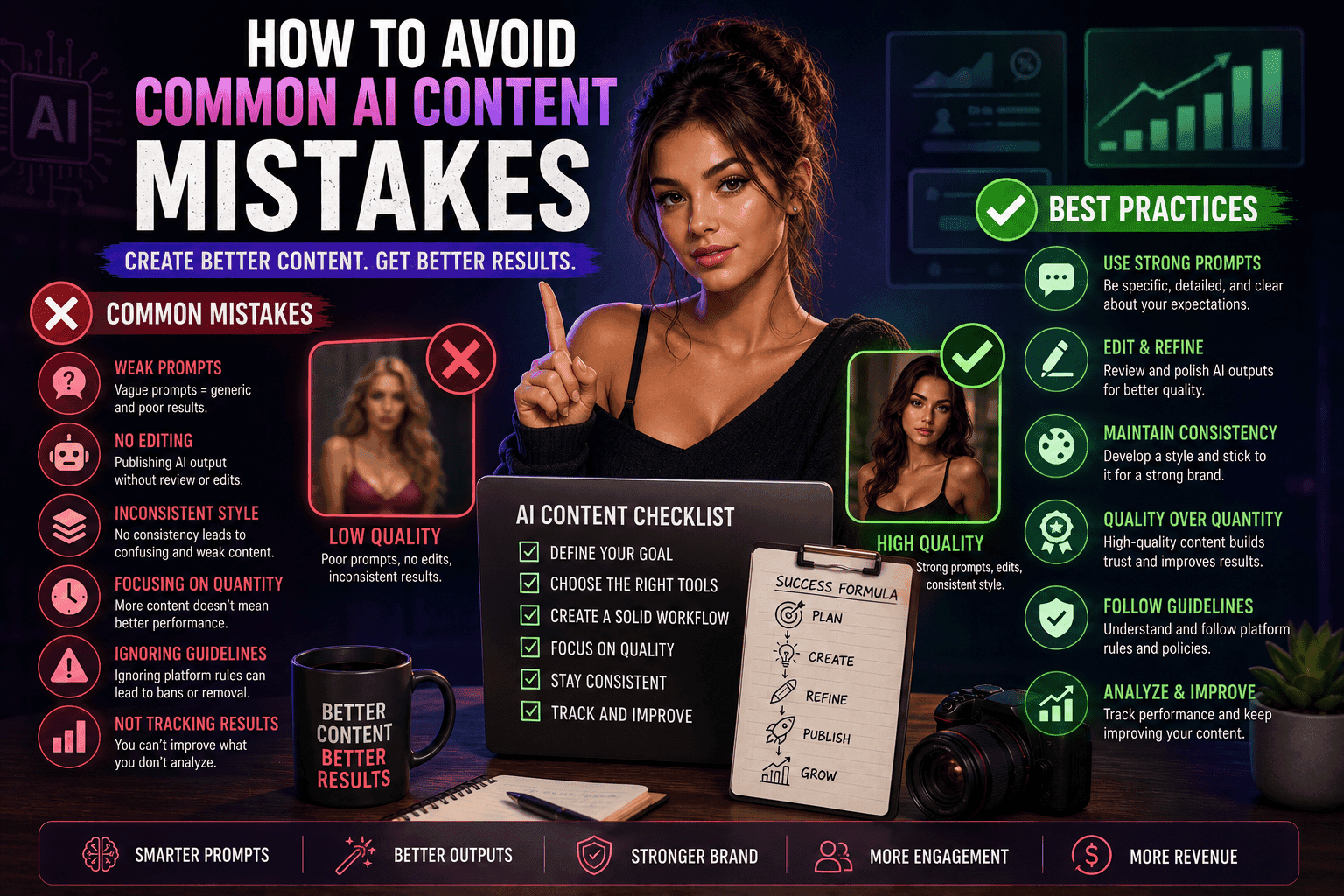
Most AI content mistakes come from poor prompts, lack of editing, and weak strategy. Fixing these improves quality, engagement, and long-term success.
10 AI Content Mistakes and Fixes for 2025
Introduction
AI content creation is powerful—but it’s also easy to get wrong.
Many beginners assume AI will do everything perfectly. The result? Low-quality content, inconsistent outputs, and little to no growth.
The good news is that most mistakes are predictable—and fixable.
In this guide, we break down the most common AI content mistakes and show you exactly how to avoid them.
1. Relying Too Much on AI Output
The mistake:
Publishing AI-generated content without editing.
What happens:
- Awkward phrasing
- Visual inconsistencies
- Low-quality results
How to fix it:
- Always review outputs
- Edit for clarity and realism
- Treat AI as a draft tool, not a final product
2. Using Weak or Vague Prompts
The mistake:
Writing short, unclear prompts.
Example:
“Beautiful woman”
Problem:
- Generic results
- Lack of detail
- Inconsistent outputs
Fix:
Use structured prompts:
- Subject
- Style
- Environment
- Details
Better example:
“Confident adult model, cinematic lighting, modern interior, soft shadows, realistic style”
3. Ignoring Consistency
The mistake:
Generating random content with no style or theme.
Result:
- No brand identity
- Confusing user experience
- Low retention
Fix:
- Stick to a consistent style
- Reuse successful prompts
- Develop recognizable patterns
4. Focusing on Quantity Over Quality
The mistake:
Publishing large volumes of low-quality content.
Reality:
- Doesn’t build trust
- Hurts SEO
- Reduces engagement
Fix:
- Publish fewer, better pieces
- Prioritize quality control
- Curate your outputs
5. Skipping the Editing Process
The mistake:
Assuming AI output is “good enough.”
Common issues:
- Grammar errors
- Visual flaws
- Inconsistent tone
Fix:
- Edit every piece
- Refine images and text
- Ensure final output looks professional
6. Not Understanding the Tools
The mistake:
Using tools without learning how they work.
Result:
- Poor output
- Frustration
- Wasted time
Fix:
- Learn basic settings
- Understand prompt behavior
- Experiment with features
7. Using Too Many Tools at Once
The mistake:
Jumping between multiple platforms.
Result:
- Confusion
- Inconsistent results
- Slower progress
Fix:
- Start with 1–2 tools
- Master them first
- Expand later
8. Ignoring SEO
The mistake:
Creating content without optimization.
What happens:
- No traffic
- Poor visibility
Fix:
- Use keywords naturally
- Structure content properly
- Add internal links
9. Not Tracking What Works
The mistake:
Creating content without analyzing results.
Result:
- No improvement
- Repeating mistakes
Fix:
- Identify top-performing content
- Save successful prompts
- Build on what works
10. Expecting Instant Results
The mistake:
Thinking AI guarantees quick success.
Reality:
- Growth takes time
- Competition is high
Fix:
- Stay consistent
- Improve gradually
- Focus on long-term strategy
11. Ignoring Platform Rules
The mistake:
Not reading content guidelines.
Risks:
- Account bans
- Content removal
Fix:
- Understand platform policies
- Stay within guidelines
- Avoid risky content
12. Poor Organization
The mistake:
Not organizing files or workflow.
Result:
- Lost content
- Slower production
Fix:
- Use clear folder systems
- Organize by project
- Backup regularly
Quick Fix Checklist
- Edit every AI output
- Use structured prompts
- Stay consistent in style
- Focus on quality
- Learn your tools
- Track performance
- Follow platform rules
FAQ Section
What is the biggest AI content mistake?
Publishing unedited content without reviewing quality.
How do I improve AI results quickly?
Use better prompts and edit outputs carefully.
Is AI content easy to master?
It’s easy to start, but improving takes practice.
Should I use multiple tools?
Not at the beginning—focus on mastering one first.
Why isn’t my content performing?
Likely due to poor quality, weak SEO, or lack of consistency.
Conclusion
AI content mistakes are common—but they’re also easy to fix once you know what to look for.
The key is simple:
Be intentional. Be consistent. And don’t rely on AI blindly.
When you combine smart strategy with proper use of AI tools, your content improves—and so do your results.